%20--%3e%3cdefs%3e%3cstyle%3e%20.st0%20{%20fill:%20%23a5d028;%20}%20.st1%20{%20fill:%20%23fff;%20}%20.st2%20{%20fill:%20%231de2db;%20}%20.st3%20{%20fill:%20%2341bdf9;%20}%20%3c/style%3e%3c/defs%3e%3cg%20id='logo-unaice-line'%3e%3cpath%20class='st1'%20d='M143.3,36.1c-1.2,0-2.1-.9-2.1-2.1V12.2c0-1.2.9-2.1,2.1-2.1s2.1.9,2.1,2.1v21.8c0,1.2-.9,2.1-2.1,2.1ZM143.2,6.2c-1.3,0-2.4-1-2.4-2.4v-.8c0-1.3,1-2.4,2.4-2.4s2.4,1.1,2.4,2.4v.8c0,1.3-1.1,2.4-2.4,2.4Z'/%3e%3cpath%20class='st3'%20d='M23.7,36.1H2c-.5,0-1-.4-1-1V2.3c0-.5.4-1,1-1h21.7c.5,0,1,.4,1,1v32.9c0,.5-.4,1-1,1'/%3e%3cpath%20class='st2'%20d='M41.8,36.1h-14.4c-.5,0-1-.4-1-1v-14.5c0-.5.4-1,1-1h14.4c.5,0,1,.4,1,1v14.5c0,.5-.4,1-1,1'/%3e%3cpath%20class='st0'%20d='M41.8,17.9h-14.4c-.5,0-1-.4-1-1V2.2c0-.5.4-1,1-1h14.4c.5,0,1,.4,1,1v14.7c0,.5-.4,1-1,1'/%3e%3c/g%3e%3cpath%20class='st1'%20d='M196.4,29.2c-2.1,2.1-3.6,3.2-7.1,3.2s-7.4-2.3-8.2-7.4h16.7c2.7,0,2.9-1.9,2.7-4-.7-6.2-5.3-11.2-11.6-11.2s-12.3,5.1-12.3,13.4,5.4,13.3,12.6,13.3,8.3-2.6,10-4.3c1.8-2.1-1.2-4.7-2.8-3ZM188.9,13.7c4.7,0,7.3,4.1,7.6,7.3h-15.3c.7-4.3,3.4-7.3,7.7-7.3Z'/%3e%3cpath%20class='st1'%20d='M132.1,12.9c-1.9-1.9-5.4-2.9-8.2-2.9s-5.3.5-8.2,1.8c-2.4,1-.9,5,1.6,3.7,2.1-1,3.3-1.5,6.3-1.5s6.7,1.1,6.8,6.1c-1.8-.5-2.7-.8-6.9-.8-6.8,0-11.3,3.3-11.3,8.8s4.1,8.4,10.1,8.4,5.4-.6,8.3-2.9v.5c0,2.8,4.2,2.6,4.2,0v-13.8c0-3.1-.8-5.5-2.7-7.4ZM130.4,26.2c0,3.6-3.4,6.3-8,6.3s-5.9-1.7-5.9-4.6,2.5-4.6,6.8-4.6c0,0,4.8,0,7.1,1v1.9Z'/%3e%3cpath%20class='st1'%20d='M80,36.1c-1.2,0-2.1-.9-2.1-2.1V3.4c0-1.2,1-2.2,2.2-2.2h.4c.8,0,1.4.4,2,1.1l20.2,25.7V3.4c0-1.2.9-2.1,2.1-2.1s2.1.9,2.1,2.1v30.7c0,1.1-.5,2-1.9,2s-1.9-.8-2.2-1.2l-20.7-26.2v25.3c0,1.2-.9,2.1-2.1,2.1Z'/%3e%3cpath%20class='st1'%20d='M60.2,36.5c-5.1,0-10.5-4.3-10.5-10.7v-13.5c0-1.2.9-2.1,2.1-2.1s2.1.9,2.1,2.1v13.1c0,4.5,2.5,7.1,6.6,7.1s7.3-3.2,7.3-7.5v-12.7c0-1.2.9-2.1,2.1-2.1s2.1.9,2.1,2.1v21.8c0,2.8-4.2,2.7-4.2,0v-.5c-1.5,1.6-3.3,2.9-7.6,2.9Z'/%3e%3cpath%20class='st1'%20d='M163.8,36.5c-7.1,0-13.1-6-13.1-13.3s4.8-13.5,13.5-13.5c4.4,0,6.9,2,8.8,3.7,1.8,1.5-.8,5.1-2.8,3.3-.8-.8-3.3-3-6.4-3-4.8,0-8.6,4-8.6,9.2s3.8,9.3,8.6,9.4c3.7,0,4.9-1,7-3.1,1.6-1.8,4.6,1,3,2.8-3,3-5.7,4.5-10,4.5h0Z'/%3e%3c/svg%3e)

GPT-4 vs. Data-to-Text – AI or Text Robot: If you are looking for a solution for automated content production, you will quickly come across these two approaches, especially in the wake of the current GPT hype. Which method is right for your company? What are the differences? Let's take a closer look:
Would you like to create content automatically or learn how text generators work? Then welcome! We will explain how Data-to-Text and GPT-4 tools automatically generate text, how they work, and where they are used.
Both GPT-4 and Data-to-Text (such as a Text Robot) are so-called NLG technologies. NLG stands for “natural language generation” and refers to the automatic generation of text in natural language. The text is generated by a Text Robot, or more precisely, a piece of software.
Both technologies have their own strengths and areas of application, but if you need large amounts of accurate and scalable text based on structured data, there is hardly any way around Data-to-Text. In this article, we take a detailed look at the differences between these two technologies and explain why Data-to-Text is the best choice for many companies.
What is Data-to-Text?
Data-to-Text describes the process of converting structured data—information that is available in clearly defined formats such as tables, databases, or APIs—into natural language text. Imagine you have a huge list of product data in a PIM (Product Information Management) system. Instead of writing each description manually, you can use this data to automatically generate product descriptions in natural language. This saves time, money, and resources and allows you to create consistent, high-quality descriptions in multiple languages.
This capability makes Data-to-Text particularly valuable for industries where scalability and precision are key. Whether you want to automate product descriptions for an online store, financial reports, or even medical reports, Data-to-Text ensures that the text corresponds exactly to the available data and can be updated at any time if the underlying data changes.
Important to know: Users have control over the text result at all times, can intervene in the text creation process at any time, and make updates or adjustments. What's more, the copies are written 100% in the desired tone, language style, and style. This ensures the consistency, expressiveness, and quality of the text. With full control, the text will sound exactly the way you want it to. The texts are also customizable and scalable.
In addition, text can be generated in multiple languages. This means you can generate the same text in English, German, Italian, and many other languages.
What is GPT-4?
GPT-4 is a neural language model based on unstructured data. It has been trained with huge amounts of text from the internet, books, and other sources and is able to generate natural language text based on this data. Unlike Data-to-Text, GPT-4 does not work with fixed data sets, but creates text by recognizing patterns in the learned texts and building new texts on them.
The strength of GPT-4 lies in its flexibility and creativity. It can generate text in many different contexts—from blog posts to poems to scripts for chatbots. The generated content is often surprisingly creative, but it is not based on precisely defined data sources, which can limit its accuracy and consistency.
Multilingualism is only possible to a limited extent with GTP-4: you can only create text in English OR German OR Italian.
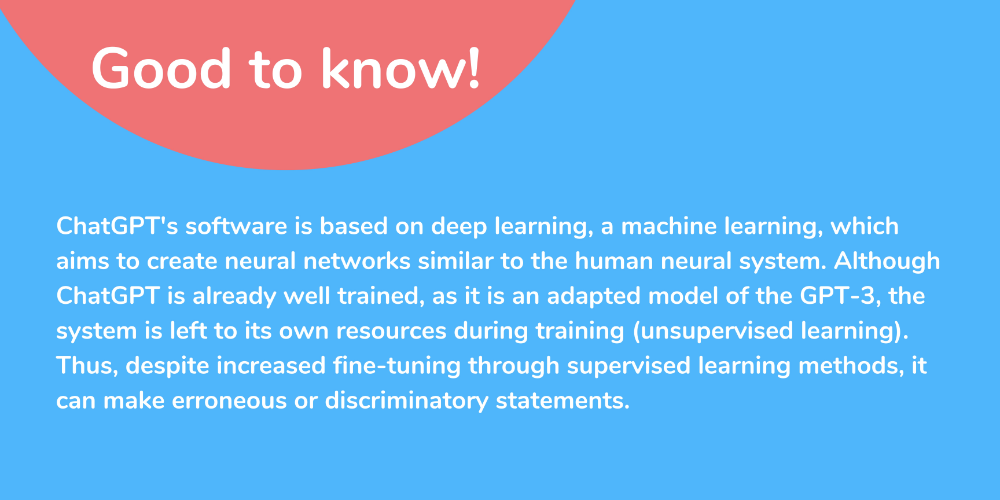
Good to know!
GPT-4 is based on the principles of deep learning and is an advanced AI model trained by neural networks to generate and understand human-like text. However, despite the advances made by GPT-4 and other deep learning models, erroneous or discriminatory statements in AI systems are still possible.
Data-to-Text vs. GPT-4: Key Differences
Structured vs. unstructured data
Probably the biggest difference between Data-to-Text and GPT-4 lies in the type of data they use. Data-to-Text is specifically designed to process structured data and create text from it. This means that the generated text is always based on clearly defined and verifiable information. This accuracy and data consistency is particularly important in areas such as e-commerce, finance, and medical documentation.
GPT-4, on the other hand, processes unstructured data. It recognizes patterns in huge amounts of text and uses them to create new content. This allows for a high degree of creativity and flexibility, but it also means that the generated content is not always accurate or correct, as it is not based on fixed data.
So which text generation technology is suitable for which use case?
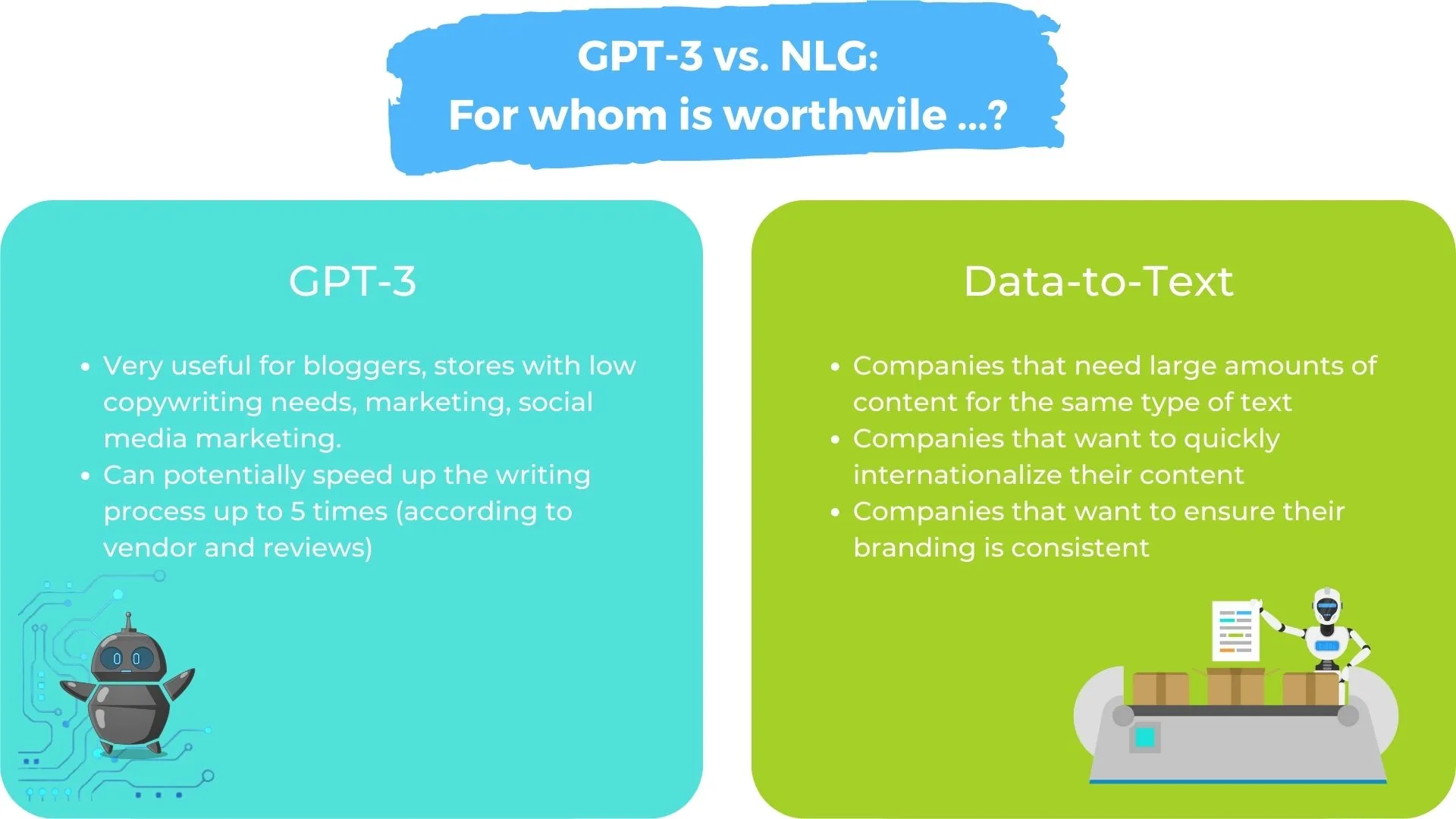
The preferred technology depends on the specific application. While GPT-4 is suitable as a basis for inspiration or as a framework for continuous text, e.g., a blog post, Data-to-Text software is used in companies that require a large amount of text due to its scalability.
Data-to-Text is used, for example, in industries such as e-commerce, banking, finance, pharmaceuticals, media, and publishing.
Data-to-Text is profitable for e-commerce companies because it allows them to create high-quality descriptions for many products with similar details – in different languages and with consistent quality. This saves time and money, increases SEO visibility, and boosts conversion rates on product pages.
Manually writing large amounts of text, such as thousands of product descriptions for an online store, is virtually impossible. This is especially true if these texts need to be revised regularly to keep them up to date, for example due to seasonal influences.
Control and adaptability
With Data-to-Text, you have full control over the output. You can specify exactly how the text is structured, the tone in which it is written, and which data should be included in the text. This control is particularly valuable if you need to ensure that the generated text complies with company guidelines or meets specific requirements—for example, in terms of language style or SEO optimization.
With GPT-4, you don't have the same level of control. The model generates text based on recognized patterns, and although you can give it inputs that steer the generated text in a certain direction, there is no guarantee that the text will have the desired structure or tone. Manual post-processing is often necessary to adapt the text to your requirements.
Scalability and efficiency
If you need to generate large amounts of text in a short period of time, Data-to-Text is unbeatable. You can create thousands of product descriptions, reports, or analyses in a matter of seconds—and in multiple languages. Once set up, the system works extremely efficiently and scalably. Changes in the data are immediately reflected in the text without you having to restart the process from scratch.
GPT-4 can also generate a lot of text, but not in the same scalable way as Data-to-Text. Since GPT-4 does not work with structured data, it is more difficult to generate large amounts of consistent text, especially if you need consistently high quality and accuracy.
Quality and consistency of the text
The text generated by Data-to-Text is always accurate because it is based directly on the data entered. The quality of the text is consistently high, and you can be sure that the information is correct and consistent. This is particularly important in areas where accurate and reliable information is essential—for example, in financial reports or medical documentation.
With GPT-4, text quality can vary greatly. Since the model is based on unstructured data, the generated text may contain incorrect or misleading information. In addition, GPT-4 lacks a deep “understanding” of the content, which can lead to text that appears superficially meaningful but, upon closer inspection, contains logical errors or gaps.
Areas of application for Data-to-Text
Data-to-Text is used in many different industries that rely on accurate and scalable text generation. Some examples are:
Multilingualism and localization
Another advantage of Data-to-Text is its ability to generate text in multiple languages. You can use the same data to create text in different languages without compromising quality. This is particularly helpful for companies that operate internationally and need consistent text in different markets.
GPT-4 can also generate multilingual text, but the precision and consistency are not at the same level as with Data-to-Text. The quality of the text often varies depending on the language, and errors in translation or adaptation to local conditions can occur.
Advantages and disadvantages of GPT-4 and Data-to-Text
Of course, both technologies have their strengths and weaknesses. Both generate text automatically – but are suitable for different use cases.
Data-to-Text is based on structured data in machine-readable form. Storytelling and writing blog posts or social media posts is therefore left to humans. GPT-4 is a valid alternative as a basis for creating this type of text, because these texts cannot be generated meaningfully with Data-to-Text software. Blog posts in particular usually deal with changing topics with completely different characteristics and features. The number of blog posts is also relatively small and is out of proportion to the one-time setup effort, which can be quite extensive.
While Data-to-Text is oriented toward user reality through data input, GPT-4 is still a neural network solution that generates language from text and has no direct connection to the real world. This means that the text inevitably has to be edited to ensure a certain level of quality and, above all, meaningfulness.
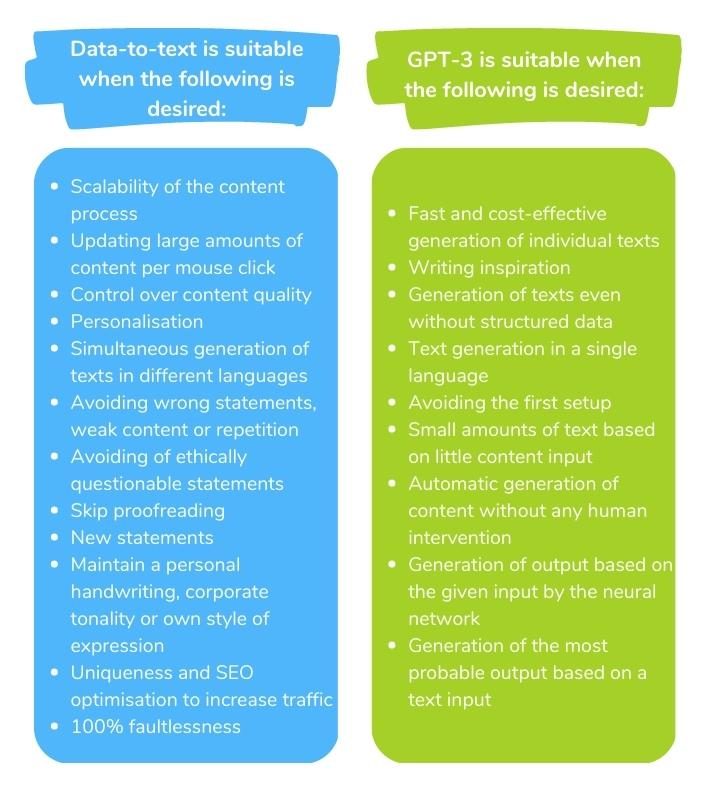
Taking into account the fact that the Data-to-Text option is always suitable when large amounts of similar content with variable details are to be generated on the basis of structured data sets, we have compiled the following comparison:
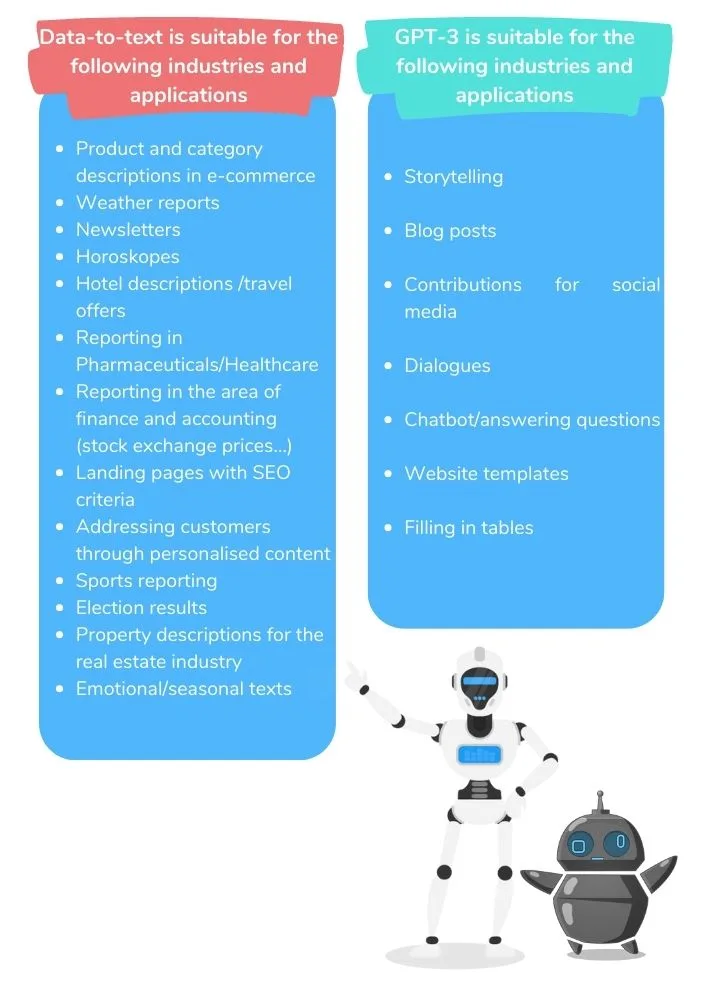
When you consider that the content in GPT-4 does not originate from a data context, it becomes clear which system is suitable for the various industries and applications.
As a general rule: If you want to emphasize special features that stand out from the crowd and highlight them across thousands of texts, then Data-to-Text is recommended. However, if it is not efficient or feasible to have the text created by a human being, and if it does not matter if repetitions occur in longer descriptions instead of additional information being added, then you should use GPT-4. This is also the case if there are no capacities available for proofreading and fact-checking.
Integration of AI in Text Robot
It should be noted at this point that AI has now also been integrated into Text Robot to automate both text generation and translation. In addition, AI is used to evaluate data and optimize text.
Conclusion: Why Data-to-Text is often the better choice
If you regularly need large amounts of accurate, data-based text, Data-to-Text is the optimal choice. This technology gives you full control over the output, enables fast and efficient scaling, and ensures that the text is always 100% error-free. While GPT-4 shows its strengths in creative or less formal text, Data-to-Text is unbeatable when it comes to transforming structured data into high-quality text. The integration of AI in the Text Robot simplifies this process and increases efficiency on several levels.